
If Everyone Is a Social Enterprise, What Does the Term Actually Mean?

The Future of Changemaking? A Discussion with Santosh Passi
By Zahara Czar, Intern at Kaaya Learning Center, May-June 2026 Third Year International Relations Student at the University of British Columbia
A decade ago, the development sector spoke the language of NGOs, charities, and philanthropy. Today, a new term dominates the conversation: social entrepreneurship. Businesses are social enterprises. NGOs are social enterprises. Startups are social enterprises. Everyone seems to be creating social impact.
During a discussion with Santosh Passi, founder of Kaaya Learning Centre, a simple question emerged: if everybody is a social enterprise, then what does the term actually mean anymore?
Perhaps the answer lies not in how organizations describe themselves, but in the challenges they face.
The Promise and Problem of Social Entrepreneurship
The appeal of social entrepreneurship is easy to understand. Rather than depending on grants and donations, organizations generate their own revenue while creating social impact. In theory, this makes change more sustainable. Impact is no longer tied to funding cycles or donor priorities.
But this promise comes with a difficult reality.
Many social enterprises operate in fields where the most important outcomes are not easily monetized. Community development, environmental stewardship, cultural preservation, and education create immense value, yet markets do not always reward them.
This leaves social enterprises in a constant balancing act. They must remain financially viable while staying true to their social purpose. They must compete in markets while serving communities. They must think like businesses without losing sight of why they exist in the first place.
In many ways, the challenge of social entrepreneurship is not creating impact. It is sustaining it.
Beyond Revenue: The Kaaya Model
Our conversation eventually turned toward Kaaya itself.
What makes Kaaya interesting as a social enterprise is that it does not treat social impact and revenue generation as separate activities. Instead, it attempts to connect them through what Santosh describes as a Value Exchange System.
The idea is simple: every interaction at Kaaya should create value for more than one person.
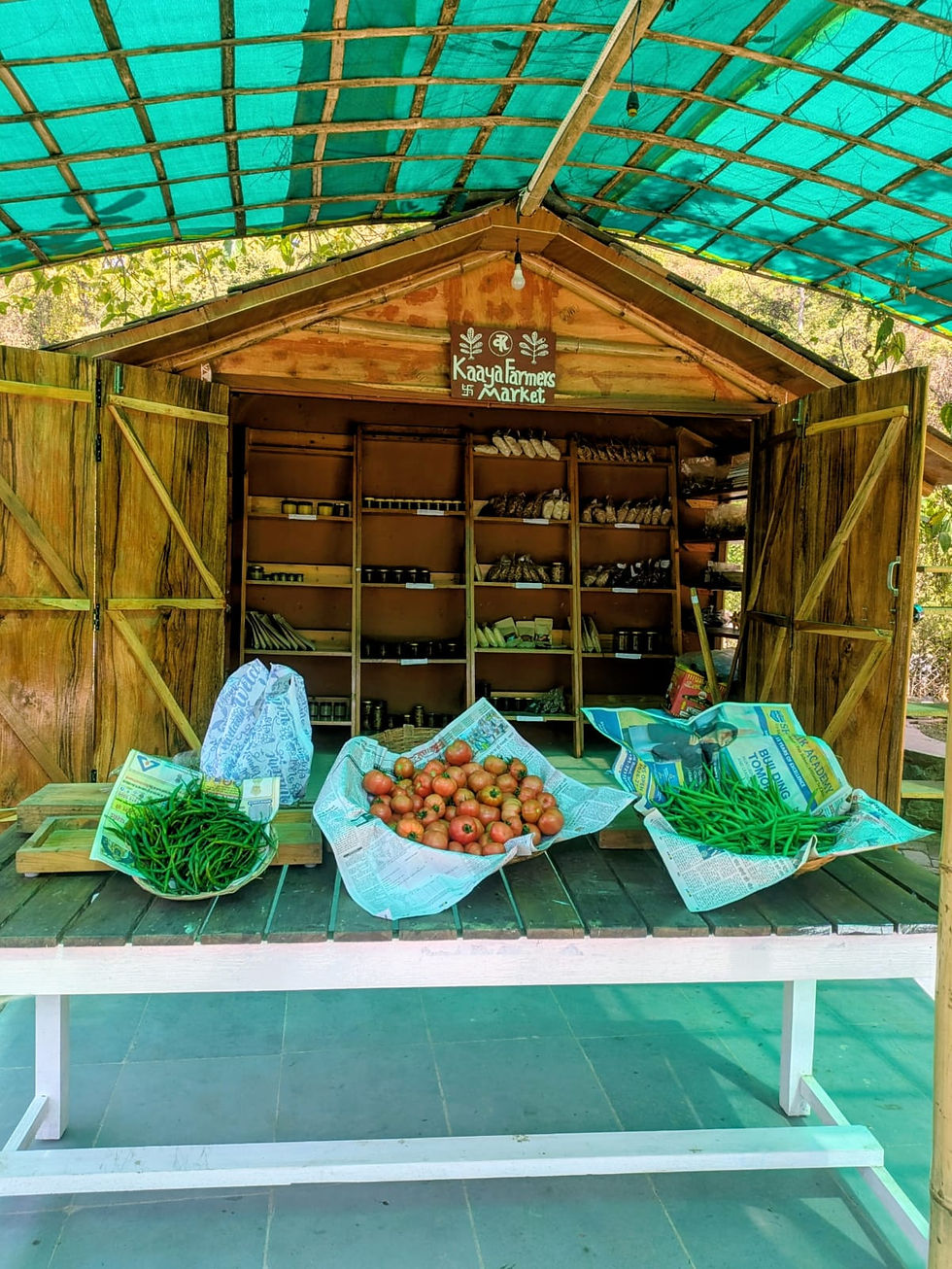
When a school pays for an environmental camp, it is not simply purchasing an educational experience. The camp generates income for local cooks, guides, and resource persons. When visitors purchase local crafts, artisans gain access to a market that may otherwise be unavailable to them. When farmers sell produce at community markets, they earn income while visitors gain access to fresh, locally grown food.
Each transaction creates a ripple effect. Revenue flows through the centre and back into the community, supporting livelihoods, skills, and local knowledge systems. Economic activity becomes a means of strengthening the social fabric rather than extracting value from it. The goal is not profit maximization. The goal is creating a system where community well-being and financial sustainability reinforce one another.
Rethinking the Future of Changemaking
Too often, discussions around development are framed as a choice between charity and markets. Yet community-rooted enterprises like Kaaya suggest a different possibility. Instead of treating communities as recipients of aid, they become participants in creating and sustaining value.
This approach is neither easy nor perfect. Social enterprises will continue to face tensions between mission and money, impact and growth, community and market pressures.
Yet as traditional funding models become increasingly uncertain, these experiments become more important.
If everyone is becoming a social enterprise, the question is no longer who carries the label. The more important question is which models genuinely create lasting value.
Perhaps the future of changemaking will belong not to the organizations that generate the most revenue or attract the most funding, but to those that build systems capable of sustaining both people and purpose.


Comments